Cost of safety while travelling in academia
Published:
I’ve now been living in Copenhagen for five months, and I absolutely love it. The biggest difference compared to the Netherlands? Here, I haven’t felt unsafe once. Not anywhere, not at any time. Because of that, I’m actively trying to tone down the constant vigilance I used to operate under. And honestly, it feels great.
The downside is that I’m now painfully aware of how much energy that constant vigilance used to take. That realization becomes even sharper when I travel for work. Conferences are supposed to be intellectually demanding. But for me, attending them also requires constant safety work: assessing risks, staying hyper-aware, planning exits, and recovering from harassment.
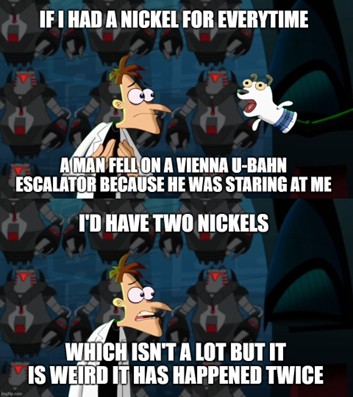
Over the past months, I’ve travelled five times for conferences, workshops, and meetings in the UK, the Netherlands (twice), Finland, and Austria. In every single one of those trips, one way or another, I was made to feel unsafe. The EGU in Vienna was a tipping point for me. Over the course of that week, I was followed, catcalled, and subjected to prolonged staring. Then, during the volunteer appreciation reception, people I know well started shouting homophobic and xenophobic chants.
I left angry and upset. And that anger is why I’m writing this.
Harassment comes in different forms for me. Sometimes it is rooted in queerphobia, sometimes in transphobia or cissexism, sometimes in misogyny, and sometimes in a combination of any of them. It can be deliberate misgendering. Being followed on the street. Prolonged, invasive staring. Catcalling. Sexual assault.
It happens everywhere: on the metro, on the street, during the day, at night, alone and in company alike. There is no reliable pattern to avoid, no place that feels entirely safe. At this point, I expect it to happen when I travel.
I have normalized it. And that feels wrong.
Because I expect harassment, I prepare. I think about routes, about timing, about what I wear, about where I can go if something happens, about local laws. I stay hyper-aware in unfamiliar environments. I scan people, exits, situations.
This takes time. This takes energy.
During trips abroad, I am more vigilant than I am at home. That constant awareness is exhausting. This is the invisible cost I pay for travelling in academia: the time, energy, and emotional labor required just to participate as safely as possible.
A ‘good’ example of this was my trip to the Ocean Sciences Meeting in Glasgow in February. It was genuinely a difficult decision whether to attend. I do not consider the UK a safe country for trans people. Especially since the Cass review in 2024 and the Supreme Court ruling last year, trans rights are increasingly under pressure in the UK (see e.g. here).
That had very concrete consequences for me.
Before travelling, I researched local laws and policies affecting trans people. One question was whether I would legally be allowed to use the women’s bathroom at the conference venue. From what I could tell, the answer was probably no, even though I might still be allowed to use women’s bathrooms in other public spaces like restaurants. Make it make sense (transphobes rarely do in my experience).
I had to think about what would happen if something went wrong. If I were arrested and strip-searched, the policies indicated that this would be done by a male officer. I could be placed in a men’s detention environment.
These are not abstract fears. They are practical considerations I have to make before attending an academic conference. This takes a toll.
People sometimes say: “Why worry about the police? If you stay out of trouble, you’ll be fine.” That is not how it works for me. As a trans person, I have been profiled by police. I have experienced transphobia within the legal system. Where others might see protection, I see a potential source of harm. The police are not automatically a safeguard for me, they are a powerful institution that can become dangerous very quickly. I am not guaranteed fair treatment. That changes how I move through the world.
I also struggle with how to respond to harassment in the moment.
During a sexual assault incident, I was much nicer than I wanted to be. The man involved was bigger and drunk, and I did not want the situation to escalate.
When people shouted homophobic chants at the reception, I was left wondering: Should I call them out directly? Should I educate these white, cishet boys how not to be a prick? Is that really my responsibility? Should I spend my energy on people making me feel unsafe? Should I report the situation? And what if I might have to work with these people in the future?
I am conflict-averse. I feel unsafe in confrontations. So often, I say nothing. And that, too, feels wrong. This is something I want to work on, something I am working on.
I was fortunate that in this instance a friend immediately stepped in when the chants were shouted. Later when I told her how it had affected me, she offered to address it to the boys on my behalf. She knew my battery was running low. That is what active allyship looks like: recognizing when someone is exhausted and stepping in rather than making them fight alone. Something I’m very grateful for.
All of this has consequences for my career and my well-being. The time and energy I spend on preparation, vigilance, and recovery from harassment cannot be spent on research, writing proposals, or building collaborations. There are also countries I simply cannot safely travel to, which limits the conferences I can attend and the networks I can build. At this stage of my career, where I am expected to establish myself, build a research group, and expand internationally, that matters.
This is not a problem unique to academia. The harassment I experience while travelling usually comes from people outside the conferences themselves. It is a societal problem. There is no simple solution. I guess dismantling the patriarchy is a good start (a girl can dream, right? RIGHT?).
I know I am not the only one experiencing this. I experience harassment that is often related to the trans, femme, and queer dimensions of my identity. Others may experience harassment linked to different characteristics and across distinct intersectional dimensions. What we share is the experience of harassment and the costs associated with it. I think it is important to make this visible and talk about it. Because for many of my colleagues, these costs are invisible. They move through conferences, cities, and travel without having to think about safety in this way. For me, that effort is constant. When institutions talk about equity in academia, these invisible costs are rarely part of the conversation. But they shape who can travel, who can network, who feels welcome at conferences, and ultimately who remains in academia.
Attending a conference is not just intellectual work. For some of us, it is also safety work.
Do you want to discuss this further? Do you have similar experiences? Do you have solutions? Feel free to reach out to me at aadbo@aqua.dtu.dk .
DISCLAIMER: note that this post has been written from MY perspective. I experience marginalization, particularly in relation to the trans, femme, and queer dimensions of my identity. At the same time, I benefit from significant privilege due to my skin color, Dutch passport, and financial situation. I believe it is important to acknowledge this, as these privileges also shape my experiences.